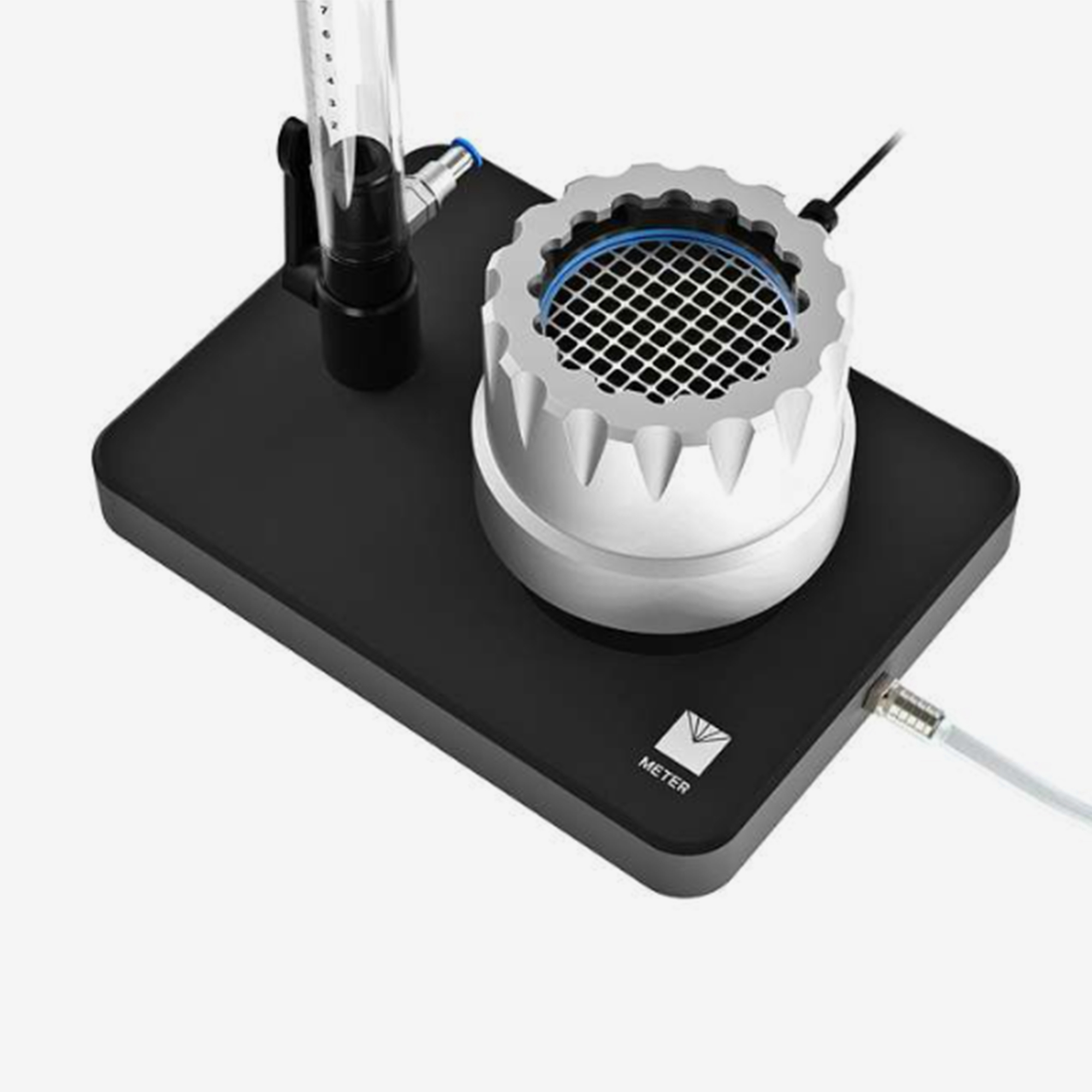
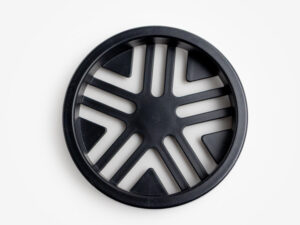
1. If your sample is not mounted properly, the base might not be tightly sealed. If this is the case, the water pressure will not approximate the value of zero hPa at the end, but tends to go to a negative value. To solve this problem, ensure that your sample is re-mounted properly. NOTE: In the early releases of KSAT, a bottom plate was used that sometimes failed to provide a tight-sealed connection to the sample, particularly if steel cylinders were scratched or dirty. The plates were replaced in the summer of 2015 by new plates with a soft, rubber sealing. Only these new ones should be used to ensure a tight connection between the sample and the dome.
2. In some soils, particularly soils with a loamy texture, almost all water passes through a very small part of the soil sample (for instance, through macropores). Water flow in these macropores becomes turbulent if the pressure gradient becomes too large. In that case, the water flow is no longer proportional to the pressure gradient, and consequently the change of the hydraulic head with time is not exponential, invalidating Darcy’s law. KSAT is a precision measurement device which shows you this by a misfit of the exponential function: the fitted function will be less curved than the data. Also, you will notice in such a case that the calculated conductivity becomes larger as the size of the pressure head decreases. Under very small gradients, flow might still be laminar. To remedy this, repeat your measurement with a small gradient (for instance, an initial pressure head < 5 cm).
3. Soils are fragile, porous systems, and their permeability might change during the measurement process. There are different directions and reasons for this:
If flow takes place primarily through macropores, these might erode during the measurement process, increasing conductivity. This will lead to a result similar to the previous case, with the difference being that the effect (increasing conductivity) is lasting.
Due to preferential flow through macropores, these can become sealed by sediment particles. In this case, conductivity will decrease during the measurement process. You will see this again by an apparent misfit of the exponential function, but in this case, the fitted exponential curve will be more curved than the data.
4. The offset of your pressure transducer might not be equal to zero. The reason for that can be that you have a temperature drift (if not all components of the measurement, i.e., KSAT, used liquid, and soil samples were equilibrated at the same temperature). To solve this problem, equilibrate all components to the same temperature, and perform the offset recalibration before the measurement.
なぜビュレット内の水位がゼロまで下がらず、正の値のところで止まってしまうのですか?
ビュレットとチューブをつないでいる配管内に空気が残っている可能性があります。空気を取り除くには、ビュレットに水を 20 cm の高さまで満たし、その状態で バルブを開放ドーム側へ一気に開けてください。水が勢いよく配管内を流れ、残っている空気を押し流してくれます。
1. If your sample is not mounted properly, it might be not tightly sealed at its base. If this is the case, the water pressure will not approximate the value of zero hPa at the end but will tend to go to a negative value. Solution: Remount the sample properly.
NOTE: In KSAT early releases, a bottom plate was used that sometimes failed to provide a tightly sealed connection to the sample, particularly if steel cylinders were scratched or dirty. The plate was replaced in summer 2015 by a new plate with a soft rubber seal. Only this updated plate should be used to ensure a tight connection between sample and dome.
2. In some soils, particularly of loamy texture, almost all water passes through a very small part of the soil sample (i.e., through macropores). Water flow in these macropores becomes turbulent if the pressure gradient becomes too large. If this is the case, the water flow is no longer proportional to the pressure gradient. Consequently, the change of the hydraulic head with time is not exponential, and Darcy’s law is not valid. If this is the case, the exponential function will not fit the data: the fitted function will be less curved than the experimental results. Also, you will notice in such cases that the smaller pressure heads give a larger calculated conductivity. Solution: Under very small gradients, flow still might be laminar. So, repeat the measurement with a small gradient (i.e., an initial pressure head < 5 cm).
3. Soils are fragile porous systems, and their permeability might change during the measurement process. There are different reasons for this:
a. If flow takes place primarily through macropores, these might erode during the measurement process (i.e., conductivity increases). This will lead to a result similar to #2, however, the effect (increasing conductivity) will be lasting.
b. Due to preferential flow, macropores can become sealed by sediment particles. In this case, conductivity will decrease during the measurement process. This will be indicated by an apparent misfit of the exponential function, but in this case, the fitted exponential curve will be more curved than the data.
4. The offset of your pressure transducer might not be equal to zero. You may have a temperature drift if all components of the measurement (i.e., KSAT, used liquid, and soil samples) were not equilibrated at the same temperature. Solution: Equilibrate all components to the same temperature, and perform the offset recalibration before the measurement.
Fontanet, Mireia, Elia Scudiero, Todd H. Skaggs, Daniel Fernàndez-Garcia, Francesc Ferrer, Gema Rodrigo, and Joaquim Bellvert."Dynamic Management Zones for Irrigation Scheduling".Agricultural Water Management 238 (2020): 106207.(記事リンク)。
Jackisch, Conrad, Kai Germer, Thomas Graeff, Ines Andrä, Katrin Schulz, Marcus Schiedung, Jaqueline Haller-Jans et al. "Soil moisture and matric potential-an open field comparison of sensor systems.".Earth System Science Data 12, no.(記事リンク)。
2016
Imukova, K.; Ingwersen, J.; Hevart, M.; Streck, T. (2016):冬小麦スタンドのエネルギー収支クロージャ-渦共分散法と土壌水収支法の比較。Biogeosciences 13 (1):63-75.
Robinson, D. A.; Jones, S. B.; Lebron, I.; Reinsch, S.; Dominguez, M. T.; Smith, A. R.; Jones, D. L.; Marshall, M. R.; Emmett, B. A. (2016):土壌水分の干ばつ誘発代替安定状態に関する実験的証拠。Scientific reports 6: 20018.
Sprenger, M.; Seeger, S.; Blume, T.; Weiler, M. (2016):バドーズゾーンにおける移動時間-空間と時間における変動性。
2015
(2015): 2015 ASABE Annual International Meeting.
Pilon, J. (2015):一時的なアクセス道路によって影響を受けた泥炭の物理的および水理学的特性の特性化。(記事リンク)
Biel-Maeso, M.; Valdes-Abellan, J.; Tamoh, K.; Corada-Fernández, C.; Candela, L. (2015):COMPARACIÓN Y VALIDACIÓN DE LAS PROPIEDADES HIDRÁULICAS DEL SUELO MEDIANTE DIFERENTES EQUIPOS DE LABORATORIO - In:Martínez Pérez, Sastre Merlín et al. (Hg.) 2015 - Estudios en la Zona no: 1-5.
Eibisch, N.; Durner, W.; Bechtold, M.; Fuß, R.; Mikutta, R.; Woche, S. K.; Helfrich, M. (2015):パイロカーとハイドロカーの撥水性は、土壌の透水特性に対するプラスの効果に対抗するか?Geoderma 245-246: 31-39.
Martínez Pérez, S.; Sastre Merlín, A.; Bienes Allas, R. (2015):Estudios en la Zona No Saturada - Vol.XII : the XII Jornadas de Investigación en la Zona No Saturada del Suelo, Alcalá de Henares, 18-20 noviembre de 2015.Universidad de Alcalá, Servicio de Publicaciones.Alcalá de Henares.(記事リンク)
Thompson, A. R.; Stotler, R. L.; Macpherson, G. L.; Liu, G. (2015):小口径注入井戸への適用を目的とした、目詰まりプロセスに関する低流量の実験室研究。Water Resour Manage (水資源管理) 29 (14):5171-5184.
Wanger, M. M.; Fox, G. A.; Wilson, G. V. (2015):Pipeflow Experiments to Quantify Pore-Water Pressure Buildup due to Pipe Clogging - In: 2015 ASABE Annual International Meeting 2015:1.(記事リンク)
Litaor, M. I.; Meir-Dinar, N.; Castro, B.; Azaizeh, H.; Rytwo, G.; Levi, N.; Levi, M.; MarChaim, U. (2015):ワイナリー廃水の通気セル移動式システムによる処理。Environmental Nanotechnology, Monitoring & Management 4: 17-26.
2014
Thompson, A. R. (2014):小口径帯水層貯留・回収井における目詰まりプロセスに及ぼす流量の影響。
2012
Durner, W.; Iden, S. C. (2012):Skript Bodenphysikalische Versuche Im Rahman der Veranstaltung "Bodenkundliches Laborpraktikum" for Studierende Geoökologie.
2009
Hartge, K. H.; Horn, R. (2009):Die physikalische Untersuchung von Böden.E. Schweizerbart'sche Verlagsbuchhandlung (Nagele u. Obermiller).Stuttgart.
2002
Coughlan, K.; Cresswell, H.; McKenzie, N. (2002):土地評価のための土壌物理学的測定と解釈.CSIRO PUBLISHING.(記事リンク)
1999
Dirksen, C. (1999):土壌物理学測定。Catena-Verl.Reiskirchen.: 2015 8th International Workshop on Advanced Ground Penetrating Radar (IWAGPR).
Leger, E.; Saintenoy, A.; Tucholka, P.; Coquet, Y.: Inverting surface GPR data to estimate wetting and drainage water retention curves in laboratory - In: 2015 8th International Workshop:1-5.(記事リンク)
Darcy, H.: Les fontaines publiques de la ville de Dijon.Dalmont.Paris.(記事リンク)